

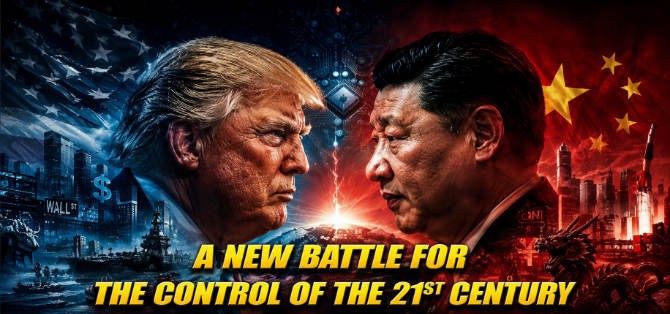
ANATOMY OF THE INTER-IMPERIALIST CONTRADICTIONS OF THE 21ST CENTURY
Can global capitalism survive the clash between its two greatest powers?
The scene unfolding during Trump’s reception appeared carefully orchestrated to convey calm: rows of flags, diplomatic smiles, handshakes, and speeches about cooperation and global stability. Yet behind that official photograph lay enormous tension. The meeting between Donald Trump and Xi Jinping was not merely a gathering between two political leaders. It was the visible reflection of a historic struggle for control of global capitalism. The United States is trying to preserve the economic and military hegemony that dominated the planet for decades, while China is emerging as a power capable of challenging that supremacy in markets, technology, finance, and global geopolitics.
BY MÁXIMO RELTI FOR CANARIAS SEMANAL.ORG
In Beijing on May 14, it was not simply two presidents who met. Facing one another in the vast halls of Chinese power sat two economic colossi locked in a dispute over control of the twenty-first century.
Donald Trump arrived accompanied by executives from Apple, Tesla, and Nvidia — in other words, by some of the leading industrial and technological minds of American capitalism.
Xi Jinping, for his part, spoke not only as China’s head of state, but as the representative of a power that no longer accepts a secondary role in the world order.
Behind the ceremonies, the flags, and the diplomatic smiles, what is truly at stake is a battle over trade routes, microchips, raw materials, artificial intelligence, military control of the Pacific, and, above all, global hegemony. Taiwan stood at the center of the discussion because one of the key pillars of contemporary capitalism is concentrated there: the production of advanced semiconductors, now essential to the digital economy, the military industry, and artificial intelligence.
Xi Jinping made it clear that Taiwan constitutes a “red line.” Trump understood the message perfectly. Because whoever controls Taiwan will not merely control an island — they will control a decisive part of the global economy.
THE NEW IMPERIALISM AND THE WAR FOR THE GLOBAL MARKET
Viewed through the lens of David Harvey’s theories on new imperialisms, this meeting represents an almost perfect expression of the contradictions of contemporary global capitalism. Harvey argues that modern imperialism no longer operates solely through classic military conquest, but through financial, technological, logistical, and commercial domination. Today’s wars do not necessarily begin with tanks entering cities, but with economic sanctions, tariff wars, technological blockades, and disputes over global production chains.
For decades, the United States has acted as the great organizing power of global capitalism. After the collapse of the Soviet Union, Washington believed it had achieved absolute dominance. Many assumed neoliberal capitalism had triumphed definitively and that no rival could challenge it. But something unexpected happened: the very globalization promoted by the United States ultimately strengthened China.
Western corporations relocated entire factories to Chinese territory in search of cheap labor, fewer environmental regulations, and enormous profits. Millions of chinese workers were absorbed into the gigantic machinery of global production. The result has proven explosive: China ceased to be merely “the world’s cheap factory” and transformed itself into a technological, financial, and military power capable of competing directly with Washington.
Here lies one of the great contradictions Harvey constantly analyzes: capitalism must expand relentlessly, yet that very expansion ends up creating new centers of power that challenge the old dominant force. That is precisely what is happening today between the United States and China.
TAIWAN: THE ISLAND WHERE THE FUTURE OF CAPITALISM IS CONCENTRATED
Trump fully understands that danger. That is why his policy toward China combines negotiation and threat. He needs trade with Beijing because major American corporations depend on the Chinese market and its industrial supply chains. At the same time, however, he seeks to slow China’s technological rise through sanctions, trade restrictions, and military pressure in Asia.
The Taiwan issue encapsulates all of this tension. For China, the island represents national sovereignty and strategic security. For the United States, Taiwan functions as a containment wall against Chinese expansion in the Pacific. But there is another decisive factor: the microchip industry. In the contemporary economy, chips are what oil was in the twentieth century. Without them, smartphones, electric vehicles, satellites, missiles, and artificial intelligence systems simply cannot function.
That is why the meeting between Trump and Xi cannot be understood as a mere diplomatic encounter. It is a negotiation between two forms of imperialism colliding within the same global capitalist system. Harvey explains that capitalism constantly needs to absorb new spaces, new markets, and new sources of profit. When growth slows down, geopolitical tensions intensify. And that is exactly what is happening today.
THE CRISIS OF GLOBAL CAPITALISM AS THE BACKDROP
The global economy is passing through a period of enormous instability. Social inequality has skyrocketed in nearly every country, public debt continues to grow uncontrollably, and the major powers are desperately seeking to maintain their levels of wealth accumulation. In that context, China no longer accepts the old distribution of global power designed by the United States after the Second World War.
Xi Jinping speaks of “strategic stability,” proposing to Trump that the two countries become “partners, not rivals.” In simple but clear terms, being someone’s “partner” means joining forces with another person, company, or state to pursue shared interests and obtain mutual benefits.
From an economic and political perspective, however, relationships between “partners” within the capitalist system are almost never relationships of genuine equality. Behind them usually lies a correlation of power. Global capitalism functions through simultaneous networks of cooperation and competition. National capitals collaborate because they need to expand markets and keep the system functioning, but they also struggle against one another to dominate it.
For that reason, when Xi Jinping proposes that China and the United States should be “partners rather than rivals,” the real message is far deeper. What he is effectively saying is something like this:
“We can share profits and stability without descending into open war.”
Yet beneath that phrase, the struggle for global hegemony persisted. Similar dynamics emerged in the interimperialist rivalries that preceded and accompanied both the First and Second World Wars. In the latter case, when Adolf Hitler desperately sought a peace agreement with Winston Churchill, he was effectively saying nothing other than:
“Let us stop destroying one another. Let us divide the colonies and make peace among ourselves.”
But in both cases, behind those words lay a much harsher reality that made such interimperialist reconciliation impossible.
Today, the objective of capitalist China is to reorganize the global balance of power in its own favor. What Washington seeks, meanwhile, is to prevent China from dismantling the order the United States established after the Second World War.
The great problem, however, is that both countries are deeply interconnected economically while simultaneously confronting each other politically. The United States needs cheap Chinese goods, and China needs American consumers. It is a relationship of mutual dependence amid fierce competition. Harvey has described this phenomenon as one of the major contradictions of globalized capitalism: national capitals cooperate and compete at the same time.
TOWARD A NEW GLOBAL DISORDER
Meanwhile, the rest of the world watches with growing concern. Europe fears becoming trapped between the two giants. Latin America is once again turning into a territory of economic dispute. Africa has emerged as a battleground for competition over strategic minerals. And East Asia is becoming increasingly militarized.
The image of Trump and Xi shaking hands in Beijing recalls, in some ways, the old diplomatic congresses of the European powers before the great world wars. They smile for the cameras while, beneath the table, gigantic economic battles are being fought.
Because the underlying problem is not simply Taiwan. The real issue is that global capitalism is undergoing a historic transition in which the old dominant power can no longer fully control the system, while the new aspiring power has not yet succeeded in replacing it. This situation generates constant friction, economic crises, trade wars, and mounting military tensions.
And perhaps therein lies the great lesson of this meeting. We are not merely witnessing a conflict between two leaders. We are witnessing the clash between two immense structures of power born from the same global economic system, struggling to determine who will lead the world in the decades ahead.
BIBLIOGRAPHY CONSULTED
- David Harvey, The New Imperialism
- David Harvey, Seventeen Contradictions and the End of Capitalism


BY MÁXIMO RELTI FOR CANARIAS SEMANAL.ORG
In Beijing on May 14, it was not simply two presidents who met. Facing one another in the vast halls of Chinese power sat two economic colossi locked in a dispute over control of the twenty-first century.
Donald Trump arrived accompanied by executives from Apple, Tesla, and Nvidia — in other words, by some of the leading industrial and technological minds of American capitalism.
Xi Jinping, for his part, spoke not only as China’s head of state, but as the representative of a power that no longer accepts a secondary role in the world order.
Behind the ceremonies, the flags, and the diplomatic smiles, what is truly at stake is a battle over trade routes, microchips, raw materials, artificial intelligence, military control of the Pacific, and, above all, global hegemony. Taiwan stood at the center of the discussion because one of the key pillars of contemporary capitalism is concentrated there: the production of advanced semiconductors, now essential to the digital economy, the military industry, and artificial intelligence.
Xi Jinping made it clear that Taiwan constitutes a “red line.” Trump understood the message perfectly. Because whoever controls Taiwan will not merely control an island — they will control a decisive part of the global economy.
THE NEW IMPERIALISM AND THE WAR FOR THE GLOBAL MARKET
Viewed through the lens of David Harvey’s theories on new imperialisms, this meeting represents an almost perfect expression of the contradictions of contemporary global capitalism. Harvey argues that modern imperialism no longer operates solely through classic military conquest, but through financial, technological, logistical, and commercial domination. Today’s wars do not necessarily begin with tanks entering cities, but with economic sanctions, tariff wars, technological blockades, and disputes over global production chains.
For decades, the United States has acted as the great organizing power of global capitalism. After the collapse of the Soviet Union, Washington believed it had achieved absolute dominance. Many assumed neoliberal capitalism had triumphed definitively and that no rival could challenge it. But something unexpected happened: the very globalization promoted by the United States ultimately strengthened China.
Western corporations relocated entire factories to Chinese territory in search of cheap labor, fewer environmental regulations, and enormous profits. Millions of chinese workers were absorbed into the gigantic machinery of global production. The result has proven explosive: China ceased to be merely “the world’s cheap factory” and transformed itself into a technological, financial, and military power capable of competing directly with Washington.
Here lies one of the great contradictions Harvey constantly analyzes: capitalism must expand relentlessly, yet that very expansion ends up creating new centers of power that challenge the old dominant force. That is precisely what is happening today between the United States and China.
TAIWAN: THE ISLAND WHERE THE FUTURE OF CAPITALISM IS CONCENTRATED
Trump fully understands that danger. That is why his policy toward China combines negotiation and threat. He needs trade with Beijing because major American corporations depend on the Chinese market and its industrial supply chains. At the same time, however, he seeks to slow China’s technological rise through sanctions, trade restrictions, and military pressure in Asia.
The Taiwan issue encapsulates all of this tension. For China, the island represents national sovereignty and strategic security. For the United States, Taiwan functions as a containment wall against Chinese expansion in the Pacific. But there is another decisive factor: the microchip industry. In the contemporary economy, chips are what oil was in the twentieth century. Without them, smartphones, electric vehicles, satellites, missiles, and artificial intelligence systems simply cannot function.
That is why the meeting between Trump and Xi cannot be understood as a mere diplomatic encounter. It is a negotiation between two forms of imperialism colliding within the same global capitalist system. Harvey explains that capitalism constantly needs to absorb new spaces, new markets, and new sources of profit. When growth slows down, geopolitical tensions intensify. And that is exactly what is happening today.
THE CRISIS OF GLOBAL CAPITALISM AS THE BACKDROP
The global economy is passing through a period of enormous instability. Social inequality has skyrocketed in nearly every country, public debt continues to grow uncontrollably, and the major powers are desperately seeking to maintain their levels of wealth accumulation. In that context, China no longer accepts the old distribution of global power designed by the United States after the Second World War.
Xi Jinping speaks of “strategic stability,” proposing to Trump that the two countries become “partners, not rivals.” In simple but clear terms, being someone’s “partner” means joining forces with another person, company, or state to pursue shared interests and obtain mutual benefits.
From an economic and political perspective, however, relationships between “partners” within the capitalist system are almost never relationships of genuine equality. Behind them usually lies a correlation of power. Global capitalism functions through simultaneous networks of cooperation and competition. National capitals collaborate because they need to expand markets and keep the system functioning, but they also struggle against one another to dominate it.
For that reason, when Xi Jinping proposes that China and the United States should be “partners rather than rivals,” the real message is far deeper. What he is effectively saying is something like this:
“We can share profits and stability without descending into open war.”
Yet beneath that phrase, the struggle for global hegemony persisted. Similar dynamics emerged in the interimperialist rivalries that preceded and accompanied both the First and Second World Wars. In the latter case, when Adolf Hitler desperately sought a peace agreement with Winston Churchill, he was effectively saying nothing other than:
“Let us stop destroying one another. Let us divide the colonies and make peace among ourselves.”
But in both cases, behind those words lay a much harsher reality that made such interimperialist reconciliation impossible.
Today, the objective of capitalist China is to reorganize the global balance of power in its own favor. What Washington seeks, meanwhile, is to prevent China from dismantling the order the United States established after the Second World War.
The great problem, however, is that both countries are deeply interconnected economically while simultaneously confronting each other politically. The United States needs cheap Chinese goods, and China needs American consumers. It is a relationship of mutual dependence amid fierce competition. Harvey has described this phenomenon as one of the major contradictions of globalized capitalism: national capitals cooperate and compete at the same time.
TOWARD A NEW GLOBAL DISORDER
Meanwhile, the rest of the world watches with growing concern. Europe fears becoming trapped between the two giants. Latin America is once again turning into a territory of economic dispute. Africa has emerged as a battleground for competition over strategic minerals. And East Asia is becoming increasingly militarized.
The image of Trump and Xi shaking hands in Beijing recalls, in some ways, the old diplomatic congresses of the European powers before the great world wars. They smile for the cameras while, beneath the table, gigantic economic battles are being fought.
Because the underlying problem is not simply Taiwan. The real issue is that global capitalism is undergoing a historic transition in which the old dominant power can no longer fully control the system, while the new aspiring power has not yet succeeded in replacing it. This situation generates constant friction, economic crises, trade wars, and mounting military tensions.
And perhaps therein lies the great lesson of this meeting. We are not merely witnessing a conflict between two leaders. We are witnessing the clash between two immense structures of power born from the same global economic system, struggling to determine who will lead the world in the decades ahead.
BIBLIOGRAPHY CONSULTED
- David Harvey, The New Imperialism
- David Harvey, Seventeen Contradictions and the End of Capitalism
















Normas de participación
Esta es la opinión de los lectores, no la de este medio.
Nos reservamos el derecho a eliminar los comentarios inapropiados.
La participación implica que ha leído y acepta las Normas de Participación y Política de Privacidad
Normas de Participación
Política de privacidad
Por seguridad guardamos tu IP
216.73.216.139