

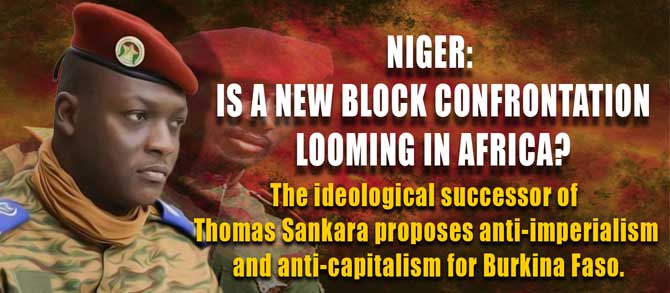
NIGER: UKRAINE VERSION 2.0? ANALYSIS AND FORECASTS ON A DANGEROUS SITUATION (VIDEO)
BURKINA FASO PICKS UP THE TORCH OF ITS ANTI-COLONIAL AND ANTI-CAPITALIST PAST
Africa seems to be in recent times, opening its eyes and taking firm steps on a renewed trajectory towards sovereignty. The recent military insurrection in Niger has exposed a growing trend that is occurring on our neighboring continent: African peoples, with repeated persistence, are beginning to try to reclaim their own history. How is Europe preparing its counteroffensive to prevent running out of vital resources for its economies? What is the "countermove" of its opponents in the other bloc?

2/08/2023
By MÁXIMO RELTI FOR CANARIAS SEMANAL.ORG
Africa seems to be waking up in recent times, opening its eyes and taking firm steps on a renewed path towards sovereignty.
The recent military insurrection in Niger has exposed a growing trend that is occurring in our neighboring continent: African peoples, with repeated persistence, are trying to reclaim their own history.
Still with some hesitations, they are beginning to try to break the chains that continue to tie them to economic and political hegemony of the West. The once all-powerful Western influence seems to have begun to fade with surprising speed, like sugar dissolves in water. Still, it is only an impression that only time, our time, will resolve in one way or another.
![[Img #76027]](https://canarias-semanal.org/upload/images/08_2023/8766_ucra-2.jpg)
ULTIMATUMS AND SANCTIONS: TWO DEVALUED RECIPES
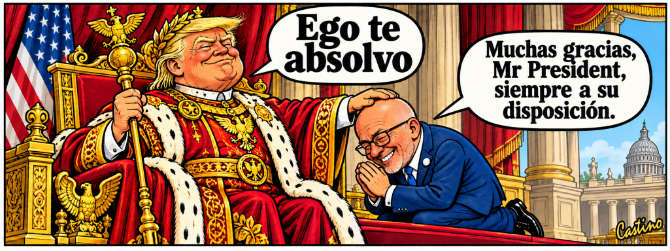
This hopeful scenario has been evidenced by the recent threat from France, along with other African and Western powers, to take military action against Niger if the country did not "return to democracy" within a week. I must confess that this French ultimatum immediately brought to mind another requirement that, following Donald Trump's orders, Spanish President Pedro Sánchez made to Venezuelan President Nicolás Maduro, urging him to resign within the next 30 days and make way for the laughable "interim president" known as Juan Guaidó. The results of Sánchez's arrogance are evident, just as the pathetic biographical ending of the Trumpist puppet show is.
This attempt at neocolonial imposition also reminded me of the ancient stories of the Spartans and Alexander the Great. According to legend, Alexander asked the Spartans whether they preferred him to enter Sparta as a friend or as an enemy, to which the Spartans responded with a single word: "Neither". This laconic response left Alexander dumbfounded, but it also made it clear that the Spartans would not willingly submit to anyone and were determined to maintain their independence.
WHAT IS REALLY BEHIND THE THREATS
However, in this case, Niger is not alone in this struggle. Burkina Faso and Mali, in a joint statement, have expressed their solidarity with Niger, warning the former colonial power that any military intervention will be considered a declaration of war. They have also refused to apply the sanctions against Niger proposed by the Economic Community of West African States (ECOWAS), an entity that the mentioned countries consider a tool of Western neocolonialism on the continent.
Guinea has also joined the list of African nations supporting Niger in its anti-colonial uprising. France, faced with this unexpected rebellion from its former African colonies, has had to quickly backtrack, despite its loud threats and ultimatums. A tactical retreat, perhaps?
However, this political situation is not coincidental. Behind any threat, pressure, or sanction, there are always economic interests that provoke them. In the case of Niger, it is the world's fourth-largest producer of uranium and the main supplier of this mineral for French nuclear power plants. From this point, the reader has more than enough elements to begin calculating what may be hidden behind the scenes. At present, highly alarming symptoms are evident: France, Spain, and other European countries have initiated a massive withdrawal of their subjects in the entire area.
The point is that, in the current stage of the conflict, such measures are not usual. Instead, this symptomatology indicates that the massive withdrawal is announcing a foreign intervention of considerable magnitude - French or European - in the entire region.
If our diagnosis were correct, it would mean that what is being prepared is a kind of "Ukrainian transposition." In other words, a transfer of the conflict posed in Eastern Europe to the African scenario, where a resource-poor Europe is staking the future of large multinational corporations for which African natural resources are essential for survival. Without them, these corporations would suffocate in just a matter of months.
We sometimes forget far too easily that Western Europe is the poorest area in resources on an overcrowded continent. Its sources of resources are found on other continents, which historically have been subject to a drastic unequal exchange that has allowed it to swim in an abundance that did not belong to it.
Meanwhile, despite uranium being one of Niger's natural resources, more than sufficient to end the poverty of its people, in that country, only 18.6% of the population has access to electricity, as recognized by statistics from the World Bank itself.
However, to the surprise of many, the West now seems more concerned about a "democracy" that has never existed in this former colony than the welfare of its population.
BURKINA FASO TAKES UP THE TORCH OF ITS ANTI-COLONIAL AND ANTI-CAPITALIST PAST
The political evolution of Burkina Faso, which takes up the torch of its past, is a very interesting case study. Its current interim president, Ibrahim Traoré, is a young military officer of just 35 years old, who ascended to power after a coup d'état in September 2022. Traoré has been inspired by the ideas and historical legacy of the renowned African leader Thomas Sankara, a political and revolutionary military figure from Burkina Faso who was assassinated by French colonialists through local traitors.
Traoré proposes an anti-imperialist and anti-capitalist political line for his country, as the only way for Africa to break free from the enslavement and exploitation imposed by Western governments and large corporations. He is aware, and has publicly stated, that his life is at stake, just as it was for his predecessor, Thomas Sankara. Watch the attached video of a speech given by the young Captain Traoré at the recent Africa-Russia Conference held in St. Petersburg. Its content will help you understand "which way the wind is blowing."
At the recent Russia-Africa Summit, Traoré delivered a powerful speech calling for a resurgence of Africa and breaking the chains that bind it to its exploiters. Traoré, conscious of the need to play with the existing contradictions between the two global capitalist blocs vying for influence in the African continent, has not hesitated for a moment to accept the support of Russia and China. And perhaps, he has not made a mistake.
A PATH FULL OF TRAPS
However, this African awakening is proving to be more than just a simple awakening. A reactivation and a restart of its path towards self-determination can be glimpsed.
There are numerous challenges that will intertwine on this path. It is still difficult to determine whether these anti-imperialist reactions in Africa are sporadic or not. However, as time has shown, it is the only safe path that the peoples of this continent - so distant and yet so close to us - can rely on to achieve liberation.
The future of Africa is at stake, and Western powers and their economic interests are facing resistance from African nations seeking autonomy and control over their natural resources. The struggle for sovereignty and self-determination in these countries is not just an internal matter, but also a battle against neocolonization and the exploitation of vital resources they need for their development.
The solidarity among African nations supporting Niger in its anti-colonial revolt is a clear message of unity and resistance against the threats and pressures of foreign powers. History teaches us that united and conscious peoples, aware of their dignity and rights, have the power to change their destiny.
Africa is waking up and taking firm steps towards self-determination and liberation from its historical chains. It is time to listen to their voices, understand their struggles, and support their path towards sovereignty and sustainable development. Only then can we build a fair and equitable world, where all peoples have the right to live in peace and prosperity.


2/08/2023
By MÁXIMO RELTI FOR CANARIAS SEMANAL.ORG
Africa seems to be waking up in recent times, opening its eyes and taking firm steps on a renewed path towards sovereignty.
The recent military insurrection in Niger has exposed a growing trend that is occurring in our neighboring continent: African peoples, with repeated persistence, are trying to reclaim their own history.
Still with some hesitations, they are beginning to try to break the chains that continue to tie them to economic and political hegemony of the West. The once all-powerful Western influence seems to have begun to fade with surprising speed, like sugar dissolves in water. Still, it is only an impression that only time, our time, will resolve in one way or another.
ULTIMATUMS AND SANCTIONS: TWO DEVALUED RECIPES
This hopeful scenario has been evidenced by the recent threat from France, along with other African and Western powers, to take military action against Niger if the country did not "return to democracy" within a week. I must confess that this French ultimatum immediately brought to mind another requirement that, following Donald Trump's orders, Spanish President Pedro Sánchez made to Venezuelan President Nicolás Maduro, urging him to resign within the next 30 days and make way for the laughable "interim president" known as Juan Guaidó. The results of Sánchez's arrogance are evident, just as the pathetic biographical ending of the Trumpist puppet show is.
This attempt at neocolonial imposition also reminded me of the ancient stories of the Spartans and Alexander the Great. According to legend, Alexander asked the Spartans whether they preferred him to enter Sparta as a friend or as an enemy, to which the Spartans responded with a single word: "Neither". This laconic response left Alexander dumbfounded, but it also made it clear that the Spartans would not willingly submit to anyone and were determined to maintain their independence.
WHAT IS REALLY BEHIND THE THREATS
However, in this case, Niger is not alone in this struggle. Burkina Faso and Mali, in a joint statement, have expressed their solidarity with Niger, warning the former colonial power that any military intervention will be considered a declaration of war. They have also refused to apply the sanctions against Niger proposed by the Economic Community of West African States (ECOWAS), an entity that the mentioned countries consider a tool of Western neocolonialism on the continent.
Guinea has also joined the list of African nations supporting Niger in its anti-colonial uprising. France, faced with this unexpected rebellion from its former African colonies, has had to quickly backtrack, despite its loud threats and ultimatums. A tactical retreat, perhaps?
However, this political situation is not coincidental. Behind any threat, pressure, or sanction, there are always economic interests that provoke them. In the case of Niger, it is the world's fourth-largest producer of uranium and the main supplier of this mineral for French nuclear power plants. From this point, the reader has more than enough elements to begin calculating what may be hidden behind the scenes. At present, highly alarming symptoms are evident: France, Spain, and other European countries have initiated a massive withdrawal of their subjects in the entire area.
The point is that, in the current stage of the conflict, such measures are not usual. Instead, this symptomatology indicates that the massive withdrawal is announcing a foreign intervention of considerable magnitude - French or European - in the entire region.
If our diagnosis were correct, it would mean that what is being prepared is a kind of "Ukrainian transposition." In other words, a transfer of the conflict posed in Eastern Europe to the African scenario, where a resource-poor Europe is staking the future of large multinational corporations for which African natural resources are essential for survival. Without them, these corporations would suffocate in just a matter of months.
We sometimes forget far too easily that Western Europe is the poorest area in resources on an overcrowded continent. Its sources of resources are found on other continents, which historically have been subject to a drastic unequal exchange that has allowed it to swim in an abundance that did not belong to it.
Meanwhile, despite uranium being one of Niger's natural resources, more than sufficient to end the poverty of its people, in that country, only 18.6% of the population has access to electricity, as recognized by statistics from the World Bank itself.
However, to the surprise of many, the West now seems more concerned about a "democracy" that has never existed in this former colony than the welfare of its population.
BURKINA FASO TAKES UP THE TORCH OF ITS ANTI-COLONIAL AND ANTI-CAPITALIST PAST
The political evolution of Burkina Faso, which takes up the torch of its past, is a very interesting case study. Its current interim president, Ibrahim Traoré, is a young military officer of just 35 years old, who ascended to power after a coup d'état in September 2022. Traoré has been inspired by the ideas and historical legacy of the renowned African leader Thomas Sankara, a political and revolutionary military figure from Burkina Faso who was assassinated by French colonialists through local traitors.
Traoré proposes an anti-imperialist and anti-capitalist political line for his country, as the only way for Africa to break free from the enslavement and exploitation imposed by Western governments and large corporations. He is aware, and has publicly stated, that his life is at stake, just as it was for his predecessor, Thomas Sankara. Watch the attached video of a speech given by the young Captain Traoré at the recent Africa-Russia Conference held in St. Petersburg. Its content will help you understand "which way the wind is blowing."
At the recent Russia-Africa Summit, Traoré delivered a powerful speech calling for a resurgence of Africa and breaking the chains that bind it to its exploiters. Traoré, conscious of the need to play with the existing contradictions between the two global capitalist blocs vying for influence in the African continent, has not hesitated for a moment to accept the support of Russia and China. And perhaps, he has not made a mistake.
A PATH FULL OF TRAPS
However, this African awakening is proving to be more than just a simple awakening. A reactivation and a restart of its path towards self-determination can be glimpsed.
There are numerous challenges that will intertwine on this path. It is still difficult to determine whether these anti-imperialist reactions in Africa are sporadic or not. However, as time has shown, it is the only safe path that the peoples of this continent - so distant and yet so close to us - can rely on to achieve liberation.
The future of Africa is at stake, and Western powers and their economic interests are facing resistance from African nations seeking autonomy and control over their natural resources. The struggle for sovereignty and self-determination in these countries is not just an internal matter, but also a battle against neocolonization and the exploitation of vital resources they need for their development.
The solidarity among African nations supporting Niger in its anti-colonial revolt is a clear message of unity and resistance against the threats and pressures of foreign powers. History teaches us that united and conscious peoples, aware of their dignity and rights, have the power to change their destiny.
Africa is waking up and taking firm steps towards self-determination and liberation from its historical chains. It is time to listen to their voices, understand their struggles, and support their path towards sovereignty and sustainable development. Only then can we build a fair and equitable world, where all peoples have the right to live in peace and prosperity.
















Normas de participación
Esta es la opinión de los lectores, no la de este medio.
Nos reservamos el derecho a eliminar los comentarios inapropiados.
La participación implica que ha leído y acepta las Normas de Participación y Política de Privacidad
Normas de Participación
Política de privacidad
Por seguridad guardamos tu IP
216.73.216.28