

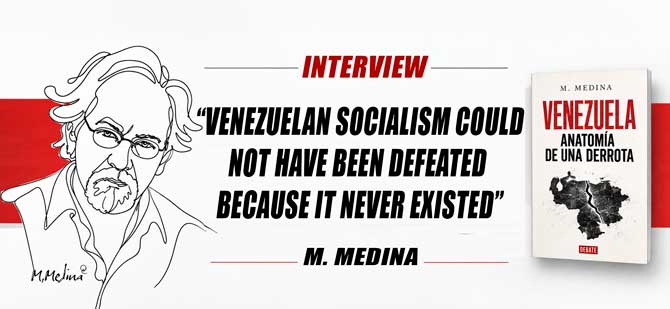
INTERVIEW WITH THE AUTHOR OF "VENEZUELA: ANATOMY OF A DEFEAT"
From the hopes awakened by Chávez to today’s oil agreement with Washington: a conversation about social class, oil, power, demobilization and the political lessons of Venezuela
M. Medina examines the limits of the Bolivarian process, the shift in oil policy toward the United States, and the silence of part of the Left in the face of a defeat that, he argues, needs to be analyzed and explained. The author of "Venezuela: Anatomy of a Defeat", a booklet that readers can download from this very page, argues that nationalizations, social spending and confrontation with Washington are not enough to transform a capitalist society, and warns of the consequences of mistaking a political experience for a transition to socialism.
REDACCIÓN CS
On this occasion, Canarias-semanal interviews Manuel Medina, a History professor, writer and regular contributor to this digital publication.
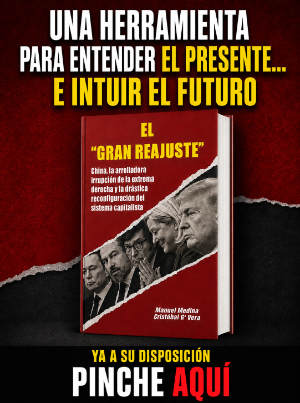
The author of several books, including "The Great Readjustment", Medina now presents "Venezuela: Anatomy of a Defeat", a booklet devoted to the same subject, which readers can download by clicking on the accompanying image.
His thesis is clear: Venezuela never became socialist. What emerged instead was a national-popular political experience that redistributed part of the country’s oil revenues, expanded rights, mobilized millions of people and challenged the United States for years, but without breaking with capitalist relations of production.
Its present and complete subordination to Washington in the oil sector would therefore not amount to a failure of socialism, although it does represent the collapse of a hope that once reached far beyond Venezuela’s borders.
In this interview, Canarias-semanal puts those conclusions to the test with some difficult questions: the impact of U.S. aggression, internal responsibility, the limits of Chavismo, the silence of part of the Left, and the danger of replacing one lost illusion with new idealizations of Russia or China.
Medina’s response revolves around a central warning: a defeat that is explained can be turned into knowledge; a defeat that is denied leads to political cynicism and demobilization.
THE INTERVIEW
![[Img #94302]](https://canarias-semanal.org/upload/images/09_2026/1903_anatomy.jpg) —You state right at the beginning of your booklet that “there was never socialism in Venezuela.” If things really were as you say, then what exactly was there, and why did so many people on the Left believe they were witnessing a process of transition toward socialism?
—You state right at the beginning of your booklet that “there was never socialism in Venezuela.” If things really were as you say, then what exactly was there, and why did so many people on the Left believe they were witnessing a process of transition toward socialism?
- What existed was a national-popular political process, involving a major redistribution of oil revenues, significant social policies, the mobilization of popular sectors, partial nationalizations and a genuine confrontation with the United States.
All of that happened, and it would be absurd either to deny it or to downplay its importance. But implementing redistributive policies within a capitalist economy is one thing; transforming the social relations on which that economic system rests is another.
In Venezuela, wage labor continued to exist, as did private ownership of the means of production and private accumulation of capital. In short, the country retained a capitalist class structure. The state played an enormous role, but a strong state is not synonymous with socialism.
Why were the two confused? Because, after the defeats suffered at the end of the twentieth century, there was an enormous need for new political reference points. Chávez spoke of socialism, confronted Washington, forged close ties with Cuba, promoted ALBA and appeared to be breaking with the neoliberal consensus. For millions of people, all of this carried enormous symbolic power.
The problem was turning that symbolic power into a characterization of Venezuelan society that the facts simply did not justify.
—If Venezuela was never socialist, why do you describe what happened as such an important defeat? What exactly has been defeated there?
—That is precisely one of the central arguments of the booklet. Venezuelan socialism has not been defeated, because it never existed. But a specific political experience has been defeated—an experience that had genuine political value—and, above all, so has the image and expectation that were constructed around it.
For years, Venezuela served for part of the Left as evidence that, even after 1991, it was still possible to open up a path of resistance to capitalism and to the United States.
That image had real political effects, even though it was based on a mistaken characterization. Its collapse can therefore have real consequences as well.
An illusion does not cease to have consequences simply because it is an illusion. It can mobilize people, generate confidence, inspire sacrifice and create expectations. And when it collapses, it can produce the opposite effects.
That is why it matters so much to understand what was actually lost. If people conclude that socialism has failed, one set of conclusions follows. If they understand that what failed was a capitalist experience presented as socialist, the conclusion may be entirely different.
—But you yourself have just acknowledged that there were nationalizations, social policies, redistribution of oil revenues and extensive popular mobilization. Where do you draw the line between progressive policies and a socialist transition?
—At the level of the relations of production and social power. That is the criterion that allows us to move beyond labels and arrive at a characterization based on the actual structure of a given society. A government can nationalize certain companies and still continue to administer capitalist relations.
It can increase social spending without the economy ceasing to depend on wage labor and private accumulation. It can even engage in a very serious confrontation with the United States, adopt anti-imperialist positions, and remain capitalist.
The decisive questions are these: Who controls the fundamental means of production? Which class actually directs the economy? Is the separation between those who own and those who sell their labor power being reduced, or is it being reproduced? Is society moving toward collective control over production, or does it remain dependent on capital accumulation? No such break took place in Venezuela. There were certainly important transformations, but they remained within clearly capitalist limits.
Moreover, even within the much narrower framework of wealth distribution, the last decade saw a reversal that has been quantified by the Central Bank of Venezuela itself. According to the Bank’s own figures, around 2015 Venezuela’s GDP was divided approximately equally between employers and the working class. By 2025, two-thirds was going to business owners and only one-third to wage earners.
These figures are far from trivial. They not only help define the nature of the economic system governing the life of the country; they also make it impossible to maintain that the process was somehow “deepening” in a “socialist” direction, as was so often claimed without any real foundation.
According to the official figures of the Central Bank itself, the exact opposite was happening. In any case, confusing social reform, economic nationalism and socialism prevents us from understanding the achievements, the setbacks and the eventual outcome of this political experience.
—Doesn’t your analysis run the risk of underestimating U.S. intervention? Venezuela was subjected for years to sanctions, pressure, attempts at isolation, and violently hostile military and political operations.
—To deny that would be to falsify history. For years, the United States acted against the Venezuelan process and bore enormous responsibility for the deterioration of the country’s economic and political conditions.
But precisely because we want to analyze what happened scientifically, we cannot turn external pressure into an all-purpose explanation.
Foreign intervention can weaken a political process, but it cannot by itself explain what social forces exist within that process, who controls the state, how a new bourgeoisie emerges, what economic interests grow up around oil revenues, or why certain institutions eventually accept a relationship with Washington that contradicts everything they proclaimed for years.
Explaining everything through imperialism can ultimately become a way of explaining nothing about what actually happened inside Venezuela.
U.S. pressure is one important part of the problem. Internal contradictions are another. To understand the outcome, both must be studied, as well as the ways in which they interacted.
—That brings us to a particularly uncomfortable question. Are we looking at a betrayal by the current leadership, or at the consequences of contradictions that had been present for much longer?
—I do not think the category of betrayal is sufficient to explain what happened. It may accurately describe the gap between what certain individuals promised and what they ultimately did.
In that sense, one can clearly speak of betrayal—betrayal of their own rhetoric and of the expectations they generated. But a political explanation cannot stop at a moral category.
When we look at what is happening, we can see that this is not simply a matter of three individuals suddenly and radically changing the direction of the process. This change is also being endorsed by major state institutions such as the National Assembly—which voted unanimously in favor of the oil agreement with the United States and other measures along the same lines—and by the United Socialist Party of Venezuela.
At that point, it becomes clear that we have to ask what material conditions made such a change possible. If everything could be explained by the sudden appearance of a few disloyal individuals, we would have an extraordinarily convenient explanation.
But the problem runs much deeper. It has to do with the social strata and classes that developed over the course of the Bolivarian political process, with the interests that consolidated themselves around the state and the oil industry, and with structural limitations that were never overcome.
Perhaps there has been betrayal. Everything seems to point in that direction. But even betrayal requires a social structure that makes it possible, and such a structure does not spring up overnight. It takes shape over many years.
—The oil agreement with the United States occupies a central place in your booklet. Why do you believe this is more than a straightforward commercial agreement?
—Because the U.S. administration itself does not describe it in those terms.
Washington has explained that the agreement gives it privileged access to a very significant share of Venezuela’s reserves, economic rights over production and mechanisms through which it can intervene in the corporate structure.
It also explicitly links those supplies to U.S. energy security, the replenishment of its Strategic Petroleum Reserve and potential military uses.
There is no need to speculate about hidden intentions. The United States itself openly states the strategic importance it attaches to the agreement. And this is where we see a historic reversal in the Venezuelan process.
For years, oil sovereignty was presented as one of the foundations of Venezuelan independence from Washington. Now part of that same resource is being incorporated into the energy-security framework of the United States.
I am not saying that every barrel of Venezuelan oil can be directly linked to a particular war. That would be an oversimplification. I am making a more basic point: a military power requires energy to sustain both its economy and its machinery of power, and Venezuela is now helping reinforce that energy supply under conditions which Washington itself considers extraordinarily favorable.
—The contrast with Cuba is particularly striking. What is the political significance of Venezuelan oil ceasing to support Cuba while at the same time becoming increasingly strategic for the United States?
—It is one of the clearest ways of seeing just how dramatically the direction has changed. For years, Venezuela supplied Cuba with a significant portion of the oil it needed.
That relationship had an economic dimension, but it also had a political one: it gave Cuba greater room for maneuver and greater autonomy in the face of U.S. pressure. Now the exact opposite is happening.
That supply is being cut while the United States gains privileged rights over Venezuelan resources and simultaneously increases energy pressure on Cuba.
It is important to understand the material significance of this change in the role assigned to Venezuelan oil. The very same resource that once helped sustain a country subjected to the U.S. blockade is now being used to reinforce the energy security of the power enforcing that blockade.
That tells us far more about the depth of the political reversal that has taken place in Venezuela than any adjective ever could.
—In the booklet, you also link Venezuelan oil to the situation in Iran and to Trump’s domestic political agenda. Isn’t there a danger of pushing the argument too far?
—Only if we claim more than we actually know. We cannot say that Venezuelan oil will determine U.S. military policy, nor can we say that Venezuela’s leaders consciously signed the agreement in order to benefit Trump electorally. We have no evidence of that.
What we do know is that the United States faces energy pressures arising from its international conflicts, that it intends to use Venezuelan oil to strengthen its Strategic Petroleum Reserve, and that the Trump administration is publicly presenting the agreement as a political victory that expands supply and may help contain prices.
So we need to distinguish between intention and effect. We do not know whether the acting government intended to help Trump. We do know that Trump is using the agreement to advance his own energy and political strategy. That distinction does not weaken the criticism. It makes it harder to refute.
—One of the more controversial arguments in your book concerns the “psychological defeat” which, according to you, what has happened in Venezuela could inflict on the international Left. Do we actually have evidence that Venezuela is demoralizing the Left?
—We do not have any worldwide statistics that would allow us to claim that there is a measurable process of demobilization caused by Venezuela, and it would be irresponsible to present the argument in those terms.
What we do have is a well-known political and historical mechanism. People need to believe that collective action can produce results.
An organization can lose a battle and continue to exist if it understands why it lost. It may even emerge intellectually stronger.
But when an experience that for years was presented as proof that another path was possible ends in something completely different, and nobody can explain why, a very dangerous spontaneous conclusion begins to emerge: “Sooner or later, it all ends up the same.”
The problem begins when that statement stops being applied only to Venezuela and starts being applied to every project of social transformation. A material defeat can be reversed. The conviction that struggle is pointless is much harder to overcome.
—In the booklet, you are particularly harsh toward those sections of the Left that defended Venezuela for years but now remain silent. What, in your view, should this Left actually do?
—Explain. Nothing more and nothing less. If they spent twenty years claiming that Venezuela was moving toward socialism, they now have to explain what happened.
If there was a break, they should identify when it occurred. If there was a betrayal, they should identify the forces that made it possible. If the process changed, they should establish how that transformation took place. And if they conclude that their original premises were mistaken from the outset, they should acknowledge it.
The worst possible approach is to construct a narrative that no event is ever allowed to challenge. When the same explanation can be used equally well to justify one thing and its opposite, it ceases to be an explanation and becomes pure metaphysics. Silence does not protect people from demoralization either. Quite the opposite.
Anyone who spent years hearing that Venezuela represented a path toward socialism and now sees what has happened needs an answer. If they do not receive one, they will come up with their own. And the easiest conclusion may be: “They’re all the same. Nothing can ever change.”
A defeat that is explained can become experience. A defeat that is denied can easily turn into sheer cynicism.
—Isn’t there a danger that such a radical critique of Venezuela ends up doing the ideological work of the Right? Someone could take the booklet you have just published and say, “See? Socialism has failed yet again.”
—That is precisely why it is essential to state clearly that socialism was not what failed. The argument made by the Right works because, for years, part of the Left itself accepted the label of socialism for things that were not socialist.
First, socialism is equated with nationalizations, social policies, a powerful state and confrontation with Washington. Then, when that government enters into crisis or changes direction, the conclusion is that socialism has failed once again.
You cannot deny that there is a certain degree of political masochism in that kind of reasoning. It is, moreover, the perfect mechanism for reactionary politics: first a false definition is manufactured, and then the outcome is used to demonstrate the failure of socialism.
The best response is not to deny the facts in order to defend a flag. It is to characterize correctly what happened. If Venezuela never broke with capitalist social relations, then its eventual outcome does not prove the impossibility of socialism. It demonstrates the limits of that particular experience.
The truth does not strengthen the Right. What strengthens the Right is our inability to explain it. The truth—and this is much more than a mere advertising slogan—is always revolutionary. Yesterday, today and tomorrow.
—At the end of the booklet, you also warn against the temptation to replace Venezuela with Russia or China as new political reference points or sources of hope. Isn’t it natural for a weakened Left to look for international allies in its opposition to the United States?
—It is one thing to analyze contradictions between major powers and make political use of certain circumstances. It is quite another to turn a state power into the agent of our own emancipation. Russia is not the Soviet Union. China cannot be analyzed through a historical snapshot taken half a century ago. Both states act according to their own economic, national and strategic interests.
We can study their conflicts with Washington, but it does not follow from this that their objectives coincide with those of the international working class.
The danger arises when every lost reference point is immediately replaced by another. First Venezuela, then Russia, tomorrow whatever other state happens to clash with the United States.
When that happens, the fundamental problem is never addressed: the weakness of the working class itself, its lack of organization and the absence of an independent political strategy. A social class that permanently needs someone else to act on its behalf has not yet built its own power.
—So after a defeat such as the Venezuelan one, what remains? What conclusion would you want someone who sincerely placed their hopes in Venezuela to draw?
—That choosing the wrong reference point does not mean the aspiration itself was wrong. Someone who believed Venezuela was moving toward socialism does not have to choose between two equally false alternatives: continuing to defend an image that the facts have destroyed, or concluding that all social transformation is impossible.
There is a third possibility: to understand why that experience was never what people believed it to be, to learn from its limitations, and to stop looking elsewhere for something that can only be built through our own organization. Defeats are unavoidable in any historical process. To establish that, we need only open a history book covering the last two centuries.
What matters is what we do with those defeats. A defeat can produce resignation if it is interpreted as proof that nothing can ever change. But it can also destroy unfounded illusions and force us to understand reality more clearly. In that sense, Venezuela’s defeat may ultimately have a paradoxical effect. It may help demobilize those who had placed their hopes in the country.
But it may also help us abandon an idea that has for far too long taken the place of serious analysis: the belief that all we need to do is find, somewhere in the world, a government, a leader or a great power capable of embodying on our behalf the future that we have not yet been able to build ourselves.
The alternative to a defeated illusion cannot be another illusion. It must be knowledge, organization and our own power.


REDACCIÓN CS
On this occasion, Canarias-semanal interviews Manuel Medina, a History professor, writer and regular contributor to this digital publication.
The author of several books, including "The Great Readjustment", Medina now presents "Venezuela: Anatomy of a Defeat", a booklet devoted to the same subject, which readers can download by clicking on the accompanying image.
His thesis is clear: Venezuela never became socialist. What emerged instead was a national-popular political experience that redistributed part of the country’s oil revenues, expanded rights, mobilized millions of people and challenged the United States for years, but without breaking with capitalist relations of production.
Its present and complete subordination to Washington in the oil sector would therefore not amount to a failure of socialism, although it does represent the collapse of a hope that once reached far beyond Venezuela’s borders.
In this interview, Canarias-semanal puts those conclusions to the test with some difficult questions: the impact of U.S. aggression, internal responsibility, the limits of Chavismo, the silence of part of the Left, and the danger of replacing one lost illusion with new idealizations of Russia or China.
Medina’s response revolves around a central warning: a defeat that is explained can be turned into knowledge; a defeat that is denied leads to political cynicism and demobilization.
THE INTERVIEW
—You state right at the beginning of your booklet that “there was never socialism in Venezuela.” If things really were as you say, then what exactly was there, and why did so many people on the Left believe they were witnessing a process of transition toward socialism?
- What existed was a national-popular political process, involving a major redistribution of oil revenues, significant social policies, the mobilization of popular sectors, partial nationalizations and a genuine confrontation with the United States.
All of that happened, and it would be absurd either to deny it or to downplay its importance. But implementing redistributive policies within a capitalist economy is one thing; transforming the social relations on which that economic system rests is another.
In Venezuela, wage labor continued to exist, as did private ownership of the means of production and private accumulation of capital. In short, the country retained a capitalist class structure. The state played an enormous role, but a strong state is not synonymous with socialism.
Why were the two confused? Because, after the defeats suffered at the end of the twentieth century, there was an enormous need for new political reference points. Chávez spoke of socialism, confronted Washington, forged close ties with Cuba, promoted ALBA and appeared to be breaking with the neoliberal consensus. For millions of people, all of this carried enormous symbolic power.
The problem was turning that symbolic power into a characterization of Venezuelan society that the facts simply did not justify.
—If Venezuela was never socialist, why do you describe what happened as such an important defeat? What exactly has been defeated there?
—That is precisely one of the central arguments of the booklet. Venezuelan socialism has not been defeated, because it never existed. But a specific political experience has been defeated—an experience that had genuine political value—and, above all, so has the image and expectation that were constructed around it.
For years, Venezuela served for part of the Left as evidence that, even after 1991, it was still possible to open up a path of resistance to capitalism and to the United States.
That image had real political effects, even though it was based on a mistaken characterization. Its collapse can therefore have real consequences as well.
An illusion does not cease to have consequences simply because it is an illusion. It can mobilize people, generate confidence, inspire sacrifice and create expectations. And when it collapses, it can produce the opposite effects.
That is why it matters so much to understand what was actually lost. If people conclude that socialism has failed, one set of conclusions follows. If they understand that what failed was a capitalist experience presented as socialist, the conclusion may be entirely different.
—But you yourself have just acknowledged that there were nationalizations, social policies, redistribution of oil revenues and extensive popular mobilization. Where do you draw the line between progressive policies and a socialist transition?
—At the level of the relations of production and social power. That is the criterion that allows us to move beyond labels and arrive at a characterization based on the actual structure of a given society. A government can nationalize certain companies and still continue to administer capitalist relations.
It can increase social spending without the economy ceasing to depend on wage labor and private accumulation. It can even engage in a very serious confrontation with the United States, adopt anti-imperialist positions, and remain capitalist.
The decisive questions are these: Who controls the fundamental means of production? Which class actually directs the economy? Is the separation between those who own and those who sell their labor power being reduced, or is it being reproduced? Is society moving toward collective control over production, or does it remain dependent on capital accumulation? No such break took place in Venezuela. There were certainly important transformations, but they remained within clearly capitalist limits.
Moreover, even within the much narrower framework of wealth distribution, the last decade saw a reversal that has been quantified by the Central Bank of Venezuela itself. According to the Bank’s own figures, around 2015 Venezuela’s GDP was divided approximately equally between employers and the working class. By 2025, two-thirds was going to business owners and only one-third to wage earners.
These figures are far from trivial. They not only help define the nature of the economic system governing the life of the country; they also make it impossible to maintain that the process was somehow “deepening” in a “socialist” direction, as was so often claimed without any real foundation.
According to the official figures of the Central Bank itself, the exact opposite was happening. In any case, confusing social reform, economic nationalism and socialism prevents us from understanding the achievements, the setbacks and the eventual outcome of this political experience.
—Doesn’t your analysis run the risk of underestimating U.S. intervention? Venezuela was subjected for years to sanctions, pressure, attempts at isolation, and violently hostile military and political operations.
—To deny that would be to falsify history. For years, the United States acted against the Venezuelan process and bore enormous responsibility for the deterioration of the country’s economic and political conditions.
But precisely because we want to analyze what happened scientifically, we cannot turn external pressure into an all-purpose explanation.
Foreign intervention can weaken a political process, but it cannot by itself explain what social forces exist within that process, who controls the state, how a new bourgeoisie emerges, what economic interests grow up around oil revenues, or why certain institutions eventually accept a relationship with Washington that contradicts everything they proclaimed for years.
Explaining everything through imperialism can ultimately become a way of explaining nothing about what actually happened inside Venezuela.
U.S. pressure is one important part of the problem. Internal contradictions are another. To understand the outcome, both must be studied, as well as the ways in which they interacted.
—That brings us to a particularly uncomfortable question. Are we looking at a betrayal by the current leadership, or at the consequences of contradictions that had been present for much longer?
—I do not think the category of betrayal is sufficient to explain what happened. It may accurately describe the gap between what certain individuals promised and what they ultimately did.
In that sense, one can clearly speak of betrayal—betrayal of their own rhetoric and of the expectations they generated. But a political explanation cannot stop at a moral category.
When we look at what is happening, we can see that this is not simply a matter of three individuals suddenly and radically changing the direction of the process. This change is also being endorsed by major state institutions such as the National Assembly—which voted unanimously in favor of the oil agreement with the United States and other measures along the same lines—and by the United Socialist Party of Venezuela.
At that point, it becomes clear that we have to ask what material conditions made such a change possible. If everything could be explained by the sudden appearance of a few disloyal individuals, we would have an extraordinarily convenient explanation.
But the problem runs much deeper. It has to do with the social strata and classes that developed over the course of the Bolivarian political process, with the interests that consolidated themselves around the state and the oil industry, and with structural limitations that were never overcome.
Perhaps there has been betrayal. Everything seems to point in that direction. But even betrayal requires a social structure that makes it possible, and such a structure does not spring up overnight. It takes shape over many years.
—The oil agreement with the United States occupies a central place in your booklet. Why do you believe this is more than a straightforward commercial agreement?
—Because the U.S. administration itself does not describe it in those terms.
Washington has explained that the agreement gives it privileged access to a very significant share of Venezuela’s reserves, economic rights over production and mechanisms through which it can intervene in the corporate structure.
It also explicitly links those supplies to U.S. energy security, the replenishment of its Strategic Petroleum Reserve and potential military uses.
There is no need to speculate about hidden intentions. The United States itself openly states the strategic importance it attaches to the agreement. And this is where we see a historic reversal in the Venezuelan process.
For years, oil sovereignty was presented as one of the foundations of Venezuelan independence from Washington. Now part of that same resource is being incorporated into the energy-security framework of the United States.
I am not saying that every barrel of Venezuelan oil can be directly linked to a particular war. That would be an oversimplification. I am making a more basic point: a military power requires energy to sustain both its economy and its machinery of power, and Venezuela is now helping reinforce that energy supply under conditions which Washington itself considers extraordinarily favorable.
—The contrast with Cuba is particularly striking. What is the political significance of Venezuelan oil ceasing to support Cuba while at the same time becoming increasingly strategic for the United States?
—It is one of the clearest ways of seeing just how dramatically the direction has changed. For years, Venezuela supplied Cuba with a significant portion of the oil it needed.
That relationship had an economic dimension, but it also had a political one: it gave Cuba greater room for maneuver and greater autonomy in the face of U.S. pressure. Now the exact opposite is happening.
That supply is being cut while the United States gains privileged rights over Venezuelan resources and simultaneously increases energy pressure on Cuba.
It is important to understand the material significance of this change in the role assigned to Venezuelan oil. The very same resource that once helped sustain a country subjected to the U.S. blockade is now being used to reinforce the energy security of the power enforcing that blockade.
That tells us far more about the depth of the political reversal that has taken place in Venezuela than any adjective ever could.
—In the booklet, you also link Venezuelan oil to the situation in Iran and to Trump’s domestic political agenda. Isn’t there a danger of pushing the argument too far?
—Only if we claim more than we actually know. We cannot say that Venezuelan oil will determine U.S. military policy, nor can we say that Venezuela’s leaders consciously signed the agreement in order to benefit Trump electorally. We have no evidence of that.
What we do know is that the United States faces energy pressures arising from its international conflicts, that it intends to use Venezuelan oil to strengthen its Strategic Petroleum Reserve, and that the Trump administration is publicly presenting the agreement as a political victory that expands supply and may help contain prices.
So we need to distinguish between intention and effect. We do not know whether the acting government intended to help Trump. We do know that Trump is using the agreement to advance his own energy and political strategy. That distinction does not weaken the criticism. It makes it harder to refute.
—One of the more controversial arguments in your book concerns the “psychological defeat” which, according to you, what has happened in Venezuela could inflict on the international Left. Do we actually have evidence that Venezuela is demoralizing the Left?
—We do not have any worldwide statistics that would allow us to claim that there is a measurable process of demobilization caused by Venezuela, and it would be irresponsible to present the argument in those terms.
What we do have is a well-known political and historical mechanism. People need to believe that collective action can produce results.
An organization can lose a battle and continue to exist if it understands why it lost. It may even emerge intellectually stronger.
But when an experience that for years was presented as proof that another path was possible ends in something completely different, and nobody can explain why, a very dangerous spontaneous conclusion begins to emerge: “Sooner or later, it all ends up the same.”
The problem begins when that statement stops being applied only to Venezuela and starts being applied to every project of social transformation. A material defeat can be reversed. The conviction that struggle is pointless is much harder to overcome.
—In the booklet, you are particularly harsh toward those sections of the Left that defended Venezuela for years but now remain silent. What, in your view, should this Left actually do?
—Explain. Nothing more and nothing less. If they spent twenty years claiming that Venezuela was moving toward socialism, they now have to explain what happened.
If there was a break, they should identify when it occurred. If there was a betrayal, they should identify the forces that made it possible. If the process changed, they should establish how that transformation took place. And if they conclude that their original premises were mistaken from the outset, they should acknowledge it.
The worst possible approach is to construct a narrative that no event is ever allowed to challenge. When the same explanation can be used equally well to justify one thing and its opposite, it ceases to be an explanation and becomes pure metaphysics. Silence does not protect people from demoralization either. Quite the opposite.
Anyone who spent years hearing that Venezuela represented a path toward socialism and now sees what has happened needs an answer. If they do not receive one, they will come up with their own. And the easiest conclusion may be: “They’re all the same. Nothing can ever change.”
A defeat that is explained can become experience. A defeat that is denied can easily turn into sheer cynicism.
—Isn’t there a danger that such a radical critique of Venezuela ends up doing the ideological work of the Right? Someone could take the booklet you have just published and say, “See? Socialism has failed yet again.”
—That is precisely why it is essential to state clearly that socialism was not what failed. The argument made by the Right works because, for years, part of the Left itself accepted the label of socialism for things that were not socialist.
First, socialism is equated with nationalizations, social policies, a powerful state and confrontation with Washington. Then, when that government enters into crisis or changes direction, the conclusion is that socialism has failed once again.
You cannot deny that there is a certain degree of political masochism in that kind of reasoning. It is, moreover, the perfect mechanism for reactionary politics: first a false definition is manufactured, and then the outcome is used to demonstrate the failure of socialism.
The best response is not to deny the facts in order to defend a flag. It is to characterize correctly what happened. If Venezuela never broke with capitalist social relations, then its eventual outcome does not prove the impossibility of socialism. It demonstrates the limits of that particular experience.
The truth does not strengthen the Right. What strengthens the Right is our inability to explain it. The truth—and this is much more than a mere advertising slogan—is always revolutionary. Yesterday, today and tomorrow.
—At the end of the booklet, you also warn against the temptation to replace Venezuela with Russia or China as new political reference points or sources of hope. Isn’t it natural for a weakened Left to look for international allies in its opposition to the United States?
—It is one thing to analyze contradictions between major powers and make political use of certain circumstances. It is quite another to turn a state power into the agent of our own emancipation. Russia is not the Soviet Union. China cannot be analyzed through a historical snapshot taken half a century ago. Both states act according to their own economic, national and strategic interests.
We can study their conflicts with Washington, but it does not follow from this that their objectives coincide with those of the international working class.
The danger arises when every lost reference point is immediately replaced by another. First Venezuela, then Russia, tomorrow whatever other state happens to clash with the United States.
When that happens, the fundamental problem is never addressed: the weakness of the working class itself, its lack of organization and the absence of an independent political strategy. A social class that permanently needs someone else to act on its behalf has not yet built its own power.
—So after a defeat such as the Venezuelan one, what remains? What conclusion would you want someone who sincerely placed their hopes in Venezuela to draw?
—That choosing the wrong reference point does not mean the aspiration itself was wrong. Someone who believed Venezuela was moving toward socialism does not have to choose between two equally false alternatives: continuing to defend an image that the facts have destroyed, or concluding that all social transformation is impossible.
There is a third possibility: to understand why that experience was never what people believed it to be, to learn from its limitations, and to stop looking elsewhere for something that can only be built through our own organization. Defeats are unavoidable in any historical process. To establish that, we need only open a history book covering the last two centuries.
What matters is what we do with those defeats. A defeat can produce resignation if it is interpreted as proof that nothing can ever change. But it can also destroy unfounded illusions and force us to understand reality more clearly. In that sense, Venezuela’s defeat may ultimately have a paradoxical effect. It may help demobilize those who had placed their hopes in the country.
But it may also help us abandon an idea that has for far too long taken the place of serious analysis: the belief that all we need to do is find, somewhere in the world, a government, a leader or a great power capable of embodying on our behalf the future that we have not yet been able to build ourselves.
The alternative to a defeated illusion cannot be another illusion. It must be knowledge, organization and our own power.














Normas de participación
Esta es la opinión de los lectores, no la de este medio.
Nos reservamos el derecho a eliminar los comentarios inapropiados.
La participación implica que ha leído y acepta las Normas de Participación y Política de Privacidad
Normas de Participación
Política de privacidad
Por seguridad guardamos tu IP
216.73.216.222